

In the pursuit of aesthetic excellence, every detail matters. The final, natural-looking result your client desires rests not just on your artistry, but on the absolute precision of your tools. Yet, selecting the ideal botox syringe can present a clinical challenge, introducing concerns over wasting precious product to ‘dead space’, ensuring unwavering dosing accuracy, and upholding your commitment to a gentle, reassuring patient experience. An incorrect choice can compromise results and undermine the very confidence you work so meticulously to build.
This professional guide is designed to provide that clarity and assurance. We will explore the critical nuances of syringe sizes, needle gauges, and specialised types, empowering you to make the most confident decision for every bespoke treatment plan. You will learn how to select the perfect instrument to eliminate product loss, guarantee injection precision, and elevate patient comfort-transforming your practice and ensuring every result is a hallmark of your expertise.
Key Takeaways
- True aesthetic artistry begins with your tools; mastering the anatomy of a syringe is the first step toward impeccable precision and patient confidence.
- Tailor your approach by matching needle gauge and length to specific treatment zones, enhancing both patient comfort and the subtlety of your results.
- Selecting the correct botox syringe with clear, precise volume markings is fundamental for ensuring safe, consistent outcomes and maximising cost-efficiency.
- Uphold your clinic’s standard of excellence by understanding the critical importance of sourcing high-quality consumables from reputable, specialised UK suppliers.
The Anatomy of a Botox Syringe: Key Components for Precision
To achieve the subtle, natural-looking results you desire, the practitioner’s skill is paramount. However, the instrument in their hand-the botox syringe-is an equally critical partner in the pursuit of aesthetic excellence. This tool is far more than a simple delivery device; it is a meticulously designed instrument where the smallest variations can significantly influence the precision, comfort, and ultimate outcome of your treatment. A botox syringe is comprised of three core parts: the barrel, the plunger, and the needle. Understanding these fundamental Hypodermic Needle Components is the first step in appreciating the artistry behind a truly bespoke injection.
Barrel and Plunger: Volume and Control
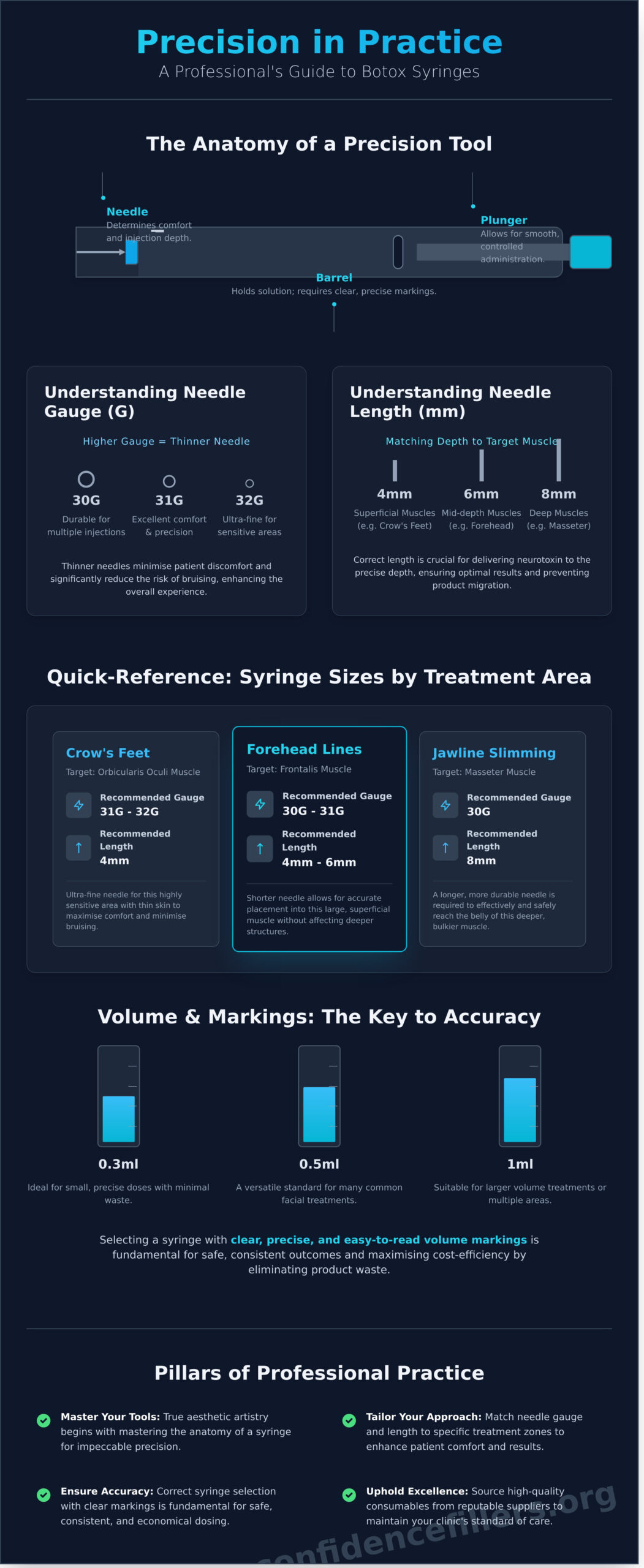
The barrel is the clear chamber that holds the botulinum toxin solution, marked with precise units to ensure accurate dosing for your specific treatment plan. The plunger, which fits snugly inside, must glide with exceptional smoothness. This control is non-negotiable; it allows your practitioner to administer the product with even, steady pressure, preventing inconsistent delivery and ensuring each unit is placed exactly where it will be most effective. In aesthetics, syringes typically come in smaller volumes-such as 0.3ml, 0.5ml, and 1ml-to allow for the fine-tuned measurements required for facial rejuvenation.
The Needle: Understanding Gauge (G)
The term ‘gauge’ (G) refers to the diameter of the needle. It operates on an inverse scale, which means the higher the gauge number, the thinner the needle. For your comfort and safety, aesthetic practitioners overwhelmingly prefer ultra-fine needles, typically 31G or 32G. Using a thinner needle is a hallmark of a gentle technique, as it minimises discomfort during the injection and significantly reduces the risk of bruising, allowing you to return to your day with confidence and minimal downtime.
The Needle: Understanding Length (mm)
Just as crucial as its thickness is the needle’s length, measured in millimetres (mm). This determines how deeply the product is delivered. The goal is to target a specific muscle without affecting surrounding tissues. Common lengths for botulinum toxin injections include 4mm, 6mm, and 8mm. The choice is tailored to your unique anatomy; for instance, a shorter 4mm needle is ideal for superficial muscles around the eyes (crow’s feet), while a slightly longer needle might be selected for deeper muscles in the forehead.
A Practical Guide to Syringe Sizes: Matching Gauge and Length to Treatment
Understanding the components of a botox syringe is the first step; applying that knowledge clinically is where artistry and precision converge. There is no single “best” syringe for every treatment. Instead, the optimal choice is a bespoke decision, tailored to the specific treatment area, your patient’s unique anatomy, and the desired aesthetic outcome. This guide provides a clear framework to help you select the ideal tools for delivering safe, effective, and natural-looking results with confidence.
Choosing the Right Needle Gauge: The Comfort vs. Durability Trade-off
The gauge of a needle directly influences both patient comfort and the instrument’s performance. For most facial neurotoxin treatments, a fine needle in the 30G to 32G range is the clinical standard. For highly sensitive areas with thin skin, such as around the eyes for crow’s feet, a 31G or an ultra-fine 32G needle is often preferred. This minimises discomfort and reduces the risk of bruising, enhancing the overall patient experience. A slightly thicker 30G needle may be more suitable for treating larger areas that require multiple injections, as it offers greater durability and is less likely to become blunt during the procedure.
Selecting Needle Length: Precision Targeting for Optimal Results
Needle length is critical for ensuring the neurotoxin is delivered to the precise depth of the target muscle. For superficial muscles, such as the frontalis in the forehead, a shorter needle of 4mm to 6mm allows for accurate placement without risking injection into deeper structures. Conversely, treating deeper, bulkier muscles like the masseter for jawline slimming requires a longer needle, typically 8mm, to effectively reach the muscle belly. Adhering to precise depths is a cornerstone of safe practice, as detailed in official resources like the FDA Botox Administration Guidelines, which outline the importance of correct anatomical targeting to prevent unwanted product migration and ensure predictable outcomes.
Quick-Reference Chart: Syringe Sizes by Treatment Area
To simplify your selection process, this chart offers our recommended botox syringe specifications for common treatment areas. Use it as a starting point for your tailored treatment plans.
Volume and Markings: The Key to Accurate and Economical Dosing
In aesthetic medicine, precision is not just a goal; it is the foundation of safety, client confidence, and beautiful, consistent outcomes. The volume and markings on your chosen botox syringe are the critical interface between your clinical expertise and the final result. An informed choice here directly impacts dosing accuracy, prevents product waste, and ultimately enhances your clinic’s profitability and reputation for excellence.
Syringe Volume: Why Smaller is Often Better
For the delicate artistry of facial rejuvenation, smaller volume syringes-typically 0.3ml or 0.5ml-offer unparalleled control. Their elongated barrels and clearer, more spaced-out markings allow you to administer fractional units with greater confidence. While larger 1ml syringes are essential for the initial reconstitution of the product, as outlined in clinical guidelines like the UCSF Botox Administration Protocol, they are less suited for the precise injection of just a few units at a time, where every marking counts.
The Great Debate: Insulin vs. Specialized ‘Unit-Marked’ Syringes
The choice between a standard insulin syringe and a specialized aesthetic one often comes down to a balance of cost and risk mitigation. Many UK clinics rely on standard insulin syringes for their cost-effectiveness and availability. However, these require practitioners to perform mental conversions from ‘insulin units’ to Botox units, introducing a potential for error. Specialized syringes, marked directly in Botox units, eliminate this conversion step, simplifying the process and enhancing safety by allowing you to focus solely on your injection artistry.
Low Dead Space: Minimizing Product Waste
‘Dead space’ is the minute volume of product trapped in the syringe hub and needle after an injection. A standard syringe can waste up to 0.05ml per use, which could be 2-5 units of Botox depending on your dilution. A low dead space (LDS) syringe is engineered to minimize this, saving valuable product with every vial.
Consider the financial impact for your practice. Saving just 3 units per vial, at a product cost of approximately £4 per unit, equates to £12 saved per vial. For a busy clinic using five vials weekly, this translates to an annual saving of over £3,000-a significant boost to your bottom line without compromising care. This commitment to efficiency and precision is a hallmark of exceptional aesthetic practice.
Sourcing High-Quality Syringes: A Pillar of Professional Practice
In the world of aesthetic medicine, your clinical skill is paramount, but the quality of your tools is a direct reflection of your professional standards. Every element, from the product you inject to the syringe you use, contributes to the patient’s experience, safety, and outcome. Sourcing your consumables with meticulous care is not an administrative task-it is a cornerstone of ethical and successful practice.
Choosing to procure supplies from non-specialized or unverified vendors introduces unacceptable risks. It compromises the integrity of the treatment and erodes the trust you have worked so hard to build with your clientele. Your supplier should be more than a transactional vendor; they should be a partner in your commitment to delivering aesthetic excellence.
The Importance of Sterility and Quality Materials
Patient safety is the foundation of every successful aesthetic treatment. This begins with an unwavering commitment to sterility. Every botox syringe you use must be medical-grade, supplied in an individually sealed, sterile blister pack. Furthermore, the quality of the materials directly impacts performance. A needle manufactured with poor quality control can be less sharp, leading to increased patient discomfort, bleeding, and bruising. These seemingly minor details accumulate, shaping your patient’s perception and satisfaction.
Why Choose a Specialized Aesthetics Supplier?
General medical suppliers serve a broad market, but a specialised aesthetics partner understands the unique demands of your craft. They appreciate the need for precision, the importance of minimising product waste with low dead space syringes, and the nuances of different injection techniques. A dedicated aesthetics supplier offers:
- A curated selection of professional-grade products, proven and trusted by leading UK practitioners.
- Expert support from a team that understands the challenges and requirements of an aesthetic clinic.
- A reliable and consistent supply chain, ensuring you have the tools you need without disruption.
Building Your Clinic’s Toolkit with Confidence
Your choice of a botox syringe ultimately comes down to a synthesis of size, quality, and specific features tailored to your technique. As your practice grows, we recommend stocking a small, versatile range of sizes to ensure you are always prepared for a bespoke treatment plan, whether you are targeting fine lines around the eyes or larger muscle groups. By partnering with a trusted supplier, you equip yourself not just with products, but with the confidence that comes from knowing every treatment is built on a foundation of safety and quality. Ensure precision and safety with our curated range of professional syringes.
Elevating Your Practice: The Final Word on Syringe Selection
Your dedication to aesthetic excellence is reflected in every tool you choose. As we’ve explored, the path to achieving subtle, natural-looking results begins with a deep understanding of your instruments. From matching the needle gauge and length to the specific treatment area for optimal patient comfort, to leveraging precise volume markings for economical and accurate dosing, every detail matters. The right botox syringe is not merely a consumable; it is an extension of your skill and a testament to your commitment to safety and superior outcomes.
At Confidence Fillers, we share your meticulous standards. That is why top aesthetic clinics across the UK and worldwide trust us to source their consumables. Every product in our comprehensive portfolio undergoes rigorous quality control, ensuring it meets the demands of your discerning practice. Equip your clinic with the finest tools. Explore our collection of professional-grade syringes now.
Continue to deliver the exceptional care and confidence your patients deserve.
Frequently Asked Questions About Botox Syringes
What is the difference between a Botox syringe and a dermal filler syringe?
The primary difference lies in their design, which is tailored to the viscosity of the product. Botulinum toxin is a watery liquid, requiring a very fine needle (e.g., 30-32G) for precise injection into muscle. Dermal fillers are thicker, gel-like substances that necessitate a wider needle (e.g., 25-27G) and often a larger syringe barrel to be injected smoothly. Each syringe is expertly designed to ensure optimal delivery, comfort, and the most effective, natural-looking result for its specific purpose.
Can I use a standard insulin syringe for Botox injections?
While an insulin syringe has a fine needle, it is not recommended for botulinum toxin treatments. Insulin syringes are calibrated in ‘insulin units’, not millilitres (ml). Botox dosage is calculated in ‘Botox units’ based on its dilution in ml of saline. Using an insulin syringe creates a significant risk of miscalculation and incorrect dosing, compromising both your safety and the aesthetic outcome. For precision and ethical care, practitioners exclusively use medical syringes marked in ml.
How many units of Botox are in a 0.5ml or 0.3ml syringe?
The number of units depends entirely on how the practitioner reconstitutes the Botox with saline. A common dilution is 100 units in 2.5ml of saline, which yields 4 units per 0.1ml. In this scenario, a 0.5ml syringe would hold 20 units, and a 0.3ml syringe would hold 12 units. Your practitioner will determine the precise, bespoke dilution needed to achieve your desired results, ensuring every treatment is tailored to your unique facial anatomy.
What does ‘low dead space’ mean and why is it important for Botox syringes?
‘Dead space’ refers to the tiny volume of product left in the hub of the syringe and needle after the plunger is fully depressed. A low dead space botox syringe is engineered to minimise this space, preventing wastage of the valuable botulinum toxin. This ensures that the maximum amount of product is delivered to the target area, providing you with a more cost-effective treatment and the precise dosage required for predictable, beautiful results.
Are Luer Lock or Luer Slip syringes better for botulinum toxin treatments?
For the meticulous work of aesthetic injections, Luer Lock syringes are widely considered superior. They feature a threaded, screw-on hub that securely locks the needle in place, preventing accidental detachment under pressure. This secure connection provides practitioners with enhanced control and safety during the procedure. A Luer Slip has a simple push-on connection, which carries a slightly higher risk of the needle slipping. The Luer Lock design ensures a seamless, safe, and precise treatment experience.
How should I safely dispose of used Botox syringes and needles?
In the United Kingdom, used syringes and needles are classified as clinical sharps waste and must be handled with extreme care. Professional aesthetic clinics adhere to strict UK health and safety regulations, placing all used sharps immediately into a designated, puncture-proof sharps bin. These bins are then collected and disposed of by a licensed clinical waste management service. This ensures the complete safety of our clients, staff, and the wider community, reflecting our commitment to the highest standards of care.