
In the pursuit of aesthetic excellence, navigating the nuanced science behind different neurotoxin formulations can feel like a constant challenge. You understand the desire for subtle, natural-looking rejuvenation, but distinguishing between the clinical characteristics of brands like Botox®, Dysport®, and Xeomin® requires absolute clarity. For the dedicated UK practitioner, a deep, evidence-based understanding of botulinum toxins is not just an advantage-it is the very foundation of ethical, effective care and instilling true client confidence.
This professional overview is designed to be your definitive resource, cutting through the noise to deliver the insights you need. We will explore the core mechanism of action, compare leading formulations on the market, and outline the best practices for sourcing and clinical application in your aesthetic clinic. Our promise is to equip you with the knowledge to make informed decisions, educate your clients with authority, and elevate your practice by delivering bespoke treatments grounded in safety and expertise.
Key Takeaways
- Understand the core science of how targeted muscle relaxation is achieved for a refined, natural-looking result.
- Discover the key differences between leading toxin formulations to select the ideal product for a client’s bespoke treatment plan.
- Master the clinical applications of botulinum toxins across all facial areas and learn the protocols that ensure paramount safety and client confidence.
- Learn to identify and secure a reputable supply chain, protecting your clinic and clients from the significant risks of unregulated products.
The Fundamental Science: How Botulinum Toxin Works
To feel confident in your treatment, it helps to understand the elegant science behind it. At its core, botulinum toxin is a highly purified neurotoxic protein produced by the bacterium Clostridium botulinum. In the world of aesthetic excellence, its power lies not in its origin, but in its precise, targeted application. Its primary function is to temporarily relax the specific muscles responsible for creating dynamic wrinkles-the lines that form from years of expression, such as crow’s feet and frown lines. This targeted relaxation smooths the overlying skin, creating a refreshed and natural-looking radiance without compromising your ability to express yourself.
Mechanism of Action: A Clinical Breakdown
Every time you smile or furrow your brow, your brain sends an electrical signal through your nerves. At the nerve ending, a chemical messenger called acetylcholine (ACh) is released, telling the muscle to contract. The mechanism of botulinum toxins is both simple and sophisticated: it interrupts this communication.
When skilfully injected, the toxin works at the neuromuscular junction-the meeting point between the nerve and the muscle. It blocks the release of ACh by cleaving essential proteins (known as SNARE proteins) that are required to transmit the signal. Without this chemical message, the muscle does not receive the command to contract and remains in a relaxed state. This process of ‘chemodenervation’ is highly localised and reversible. For those seeking a deeper scientific explanation, a comprehensive overview of botulinum toxin provides extensive detail. Your body naturally begins to form new nerve connections over three to four months, which is why follow-up treatments are part of a bespoke plan to maintain your beautifully subtle results.
Understanding Serotypes and Potency
While there are several serotypes of the toxin (A-H), Type A is the gold standard for aesthetic treatments in the UK and globally. Its high potency and predictable duration of effect make it the ideal choice for softening expression lines with precision and artistry. Type B is also approved for medical use but is rarely used in cosmetics.
A critical aspect of your safety is understanding that the ‘units’ used to measure dosage are specific to each brand (e.g., Botox®, Azzalure®, Bocouture®). These units are not interchangeable. This is precisely why your treatment must be administered by an expert practitioner who understands the nuanced differences and can tailor the exact dose for your unique facial anatomy and aesthetic goals, ensuring a safe journey to renewed confidence.
A Comparative Look at Major Botulinum Toxin Formulations
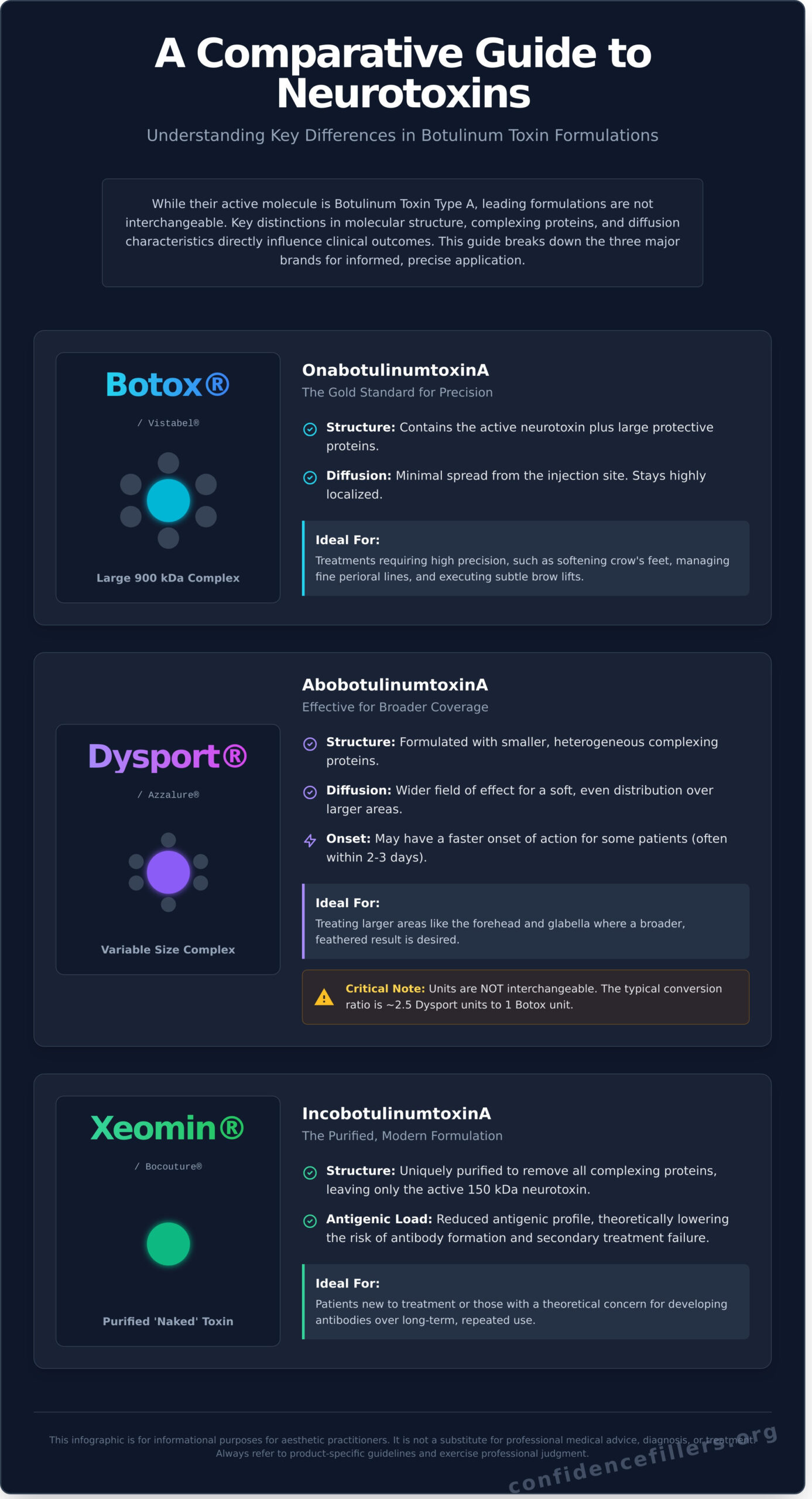
While the active molecule at the heart of all aesthetic neurotoxins is Botulinum neurotoxin type A, it’s a common misconception that all formulations are interchangeable. For your practitioner, understanding the subtle yet significant differences between brands is fundamental to creating a bespoke treatment plan that delivers predictable, beautiful, and natural-looking results. The key distinctions lie in molecular structure, the presence of complexing proteins, and diffusion characteristics-factors that influence how the product behaves once administered. This meticulous understanding of the different botulinum toxins is what separates standard practice from true aesthetic artistry. For a deeper look into the science, this in-depth scientific review provides comprehensive detail on the neurotoxin’s mechanism.
OnabotulinumtoxinA (Botox®/Vistabel®)
As the original and most extensively researched formulation, Botox® is the gold standard in the industry. Its structure includes the active neurotoxin surrounded by protective proteins, forming a 900 kDa complex. This larger size results in minimal diffusion, meaning it stays very close to the injection point. This characteristic makes it the ideal choice for treatments requiring absolute precision, such as a subtle brow lift or the meticulous softening of fine lines around the eyes, ensuring a targeted and controlled outcome.
AbobotulinumtoxinA (Dysport®/Azzalure®)
Dysport® is formulated with smaller complexing proteins, which gives it a wider field of effect and faster onset for some patients. This broader diffusion can be a distinct advantage when treating larger areas, like the forehead, as it allows for a soft, even distribution that smooths widespread lines beautifully. It’s crucial to note that its units are not equivalent to Botox; a skilled practitioner understands the specific conversion ratio (approximately 2.5:1) to ensure both safety and efficacy.
IncobotulinumtoxinA (Xeomin®/Bocouture®)
Often referred to as the ‘naked’ toxin, Xeomin® is uniquely purified to remove all complexing proteins, leaving only the active neurotoxin. The theoretical benefit of this is a reduced antigenic load, potentially lowering the very small risk of patients developing antibodies and becoming resistant to treatment over time. It shares a 1:1 unit ratio with Botox and is celebrated for its precise action, making it another excellent option for targeted, high-fidelity treatments.
Emerging Formulations (e.g., Nabota®, Jeuveau®)
The landscape of botulinum toxins is continually evolving, with highly effective new formulations emerging, particularly from South Korea. Brands like Nabota® and Jeuveau® are gaining prominence in the global market. Often structurally similar to the original 900 kDa complex of Botox, they present themselves as effective and often cost-competitive alternatives, expanding the range of premium tools available to your practitioner to perfectly tailor your aesthetic journey.
Clinical Applications in Aesthetic Medicine
In the realm of aesthetic medicine, the primary goal of using botulinum toxins is to artfully manage dynamic rhytids-the lines and wrinkles that form from your natural facial expressions. By precisely relaxing specific muscles, we can smooth the skin’s surface, restoring a serene and refreshed appearance that reflects your inner vitality. This approach has evolved significantly, moving beyond purely corrective treatments to encompass preventative strategies for younger clients wishing to inhibit the formation of deep-set lines. It is crucial to understand that the applications outlined here are for informational purposes and not a training protocol; a bespoke treatment plan from a qualified medical professional is paramount for safety and efficacy. Sourcing authentic, approved products is equally vital, as highlighted by official FDA safety information on the risks of unregulated substances.
Upper Face: The Core Treatment Areas
The upper third of the face is where botulinum toxin treatments first gained prominence, and it remains the cornerstone of aesthetic rejuvenation. These foundational treatments deliver consistently beautiful, natural-looking results that enhance your confidence.
- Glabellar Complex: Targeting the vertical ’11’ lines between the eyebrows, this treatment softens a furrowed or concerned expression, leaving you looking more relaxed and approachable.
- Frontalis Muscle: We address the horizontal lines across the forehead to create a smoother canvas. The artistry lies in achieving this rejuvenation while preserving natural expression and brow position.
- Orbicularis Oculi: By gently relaxing the muscle around the eyes, we can soften the lateral canthal lines, or ‘crow’s feet’, that appear when you smile, allowing your eyes to shine with renewed radiance.
Advanced and Off-Label Applications
Beyond the core areas, an experienced practitioner can use advanced techniques to create subtle yet impactful enhancements, achieving a harmonious balance across the entire facial structure. These treatments require a profound understanding of facial anatomy.
- Masseter Reduction: For those seeking a slimmer, more refined jawline or relief from teeth grinding (bruxism), treating the masseter muscles can provide both aesthetic and functional benefits.
- The ‘Lip Flip’: A meticulous application to the upper lip muscle can create a subtle eversion, or ‘flip’, making the lip appear fuller without adding volume.
- DAO Treatment: By relaxing the Depressor Anguli Oris muscles, we can lift downturned corners of the mouth, restoring a more neutral and pleasant resting expression.
- Platysmal Bands: Prominent vertical bands on the neck can be softened, leading to a smoother, more youthful neck profile and a seamless transition from face to décolletage.
Safety, Efficacy, and Client Management
Achieving aesthetic excellence with botulinum toxins requires more than precise injection technique; it demands an unwavering commitment to client safety and a sophisticated approach to managing their journey. The high efficacy and satisfaction rates associated with these treatments are directly linked to a foundation of trust, built through transparent communication and meticulous clinical practice.
Safety Profile and Contraindications
While the safety profile is well-established, a practitioner’s first duty is to ensure a client is a suitable candidate. A thorough understanding of potential side effects is essential for both practitioner and client. Most are transient and mild, resolving within days.
- Common Effects: Temporary erythema (redness), localised edema (swelling), bruising at the injection site, and mild headaches.
- Less Common Risks: Asymmetry, brow or eyelid ptosis (drooping), and diplopia (double vision). These are rare when administered by a skilled professional and are typically temporary.
- Absolute Contraindications: Known allergies to any component of the formulation, active infection at the treatment site, certain neuromuscular disorders (e.g., Myasthenia Gravis), and pregnancy or breastfeeding.
Managing Client Expectations
Your client’s confidence in the outcome begins with a clear understanding of the treatment timeline. It is vital to communicate that results are not immediate. The onset of action for botulinum toxins typically begins within 3-7 days, with the peak effect-a smoother, more refreshed appearance-becoming visible at around two weeks. The rejuvenating effects generally last for 3-4 months. Emphasising the importance of follow-up appointments and a consistent treatment plan helps maintain natural-looking results and fosters a lasting professional relationship.
The Consultation: Assessment and Planning
The consultation is the cornerstone of a successful, bespoke treatment. It moves beyond a static view of the face to include a dynamic muscle assessment, observing how your client’s unique expressions create lines and folds. This detailed analysis informs a precise treatment plan, which must be documented alongside signed informed consent. Clearly communicating what can realistically be achieved ensures the final result aligns with your client’s desires for subtle enhancement, paving the way for renewed self-assurance. This meticulous planning is the foundation of every treatment journey at Confidence Fillers.
Sourcing and Handling: Clinic Best Practices
Delivering aesthetic excellence and building patient confidence begins not with the injection, but with the integrity of the product itself. For practitioners dedicated to the highest standards of care, meticulous sourcing and handling of botulinum toxins are non-negotiable. Upholding these best practices is the bedrock of a safe, ethical, and reputable clinic, ensuring that every treatment you provide is underpinned by quality and accountability.
Ensuring Product Authenticity
The rise of counterfeit and unregulated products poses a significant risk to both patient safety and your professional standing. It is critical to establish a verified supply chain, procuring products exclusively from manufacturer-approved pharmacies and licensed suppliers who provide full traceability. Always inspect packaging upon arrival for security holograms, verifiable lot numbers, and clear expiry dates. Your commitment to authenticity is a direct reflection of your commitment to your clients’ well-being. Source authentic, globally-recognized botulinum toxins from a trusted supplier.
Storage and Reconstitution Guidelines
The delicate protein structure of botulinum toxin requires precise handling to maintain its potency and ensure predictable, natural-looking results. Adhering to manufacturer-specific protocols is essential for preserving the product’s integrity from storage to administration.
- Proper Storage: Unopened vials must be stored at recommended temperatures, typically refrigerated between 2°C and 8°C or frozen, as specified by the manufacturer. Maintaining a consistent cold chain is paramount.
- Meticulous Reconstitution: Use only sterile, preservative-free 0.9% sodium chloride for reconstitution. The diluent should be introduced gently into the vial to avoid creating foam or bubbles, which can denature the protein.
- Gentle Handling: After adding saline, gently swirl the vial to dissolve the powder. Avoid vigorous shaking or agitation, as this can compromise the molecule’s efficacy.
- Usage Window: Once reconstituted, the product should typically be used within 24 hours and kept refrigerated to ensure optimal potency and safety.
In the United Kingdom, all practitioners must operate strictly within the legal framework governed by the Medicines and Healthcare products Regulatory Agency (MHRA). This includes ensuring that all treatments are prescribed by a qualified independent prescriber following a face-to-face consultation. Adherence to these regulations is fundamental to ethical practice and the safeguarding of your patients.
Elevating Your Practice with Botulinum Toxin Expertise
As we have explored, a command of aesthetic medicine is built upon two core pillars: a profound understanding of the science behind botulinum toxins and a steadfast commitment to patient safety. Grasping the nuanced differences between formulations allows you to create truly bespoke treatment plans, while ethical sourcing and meticulous handling protocols ensure that every procedure is underpinned by clinical excellence and integrity. These principles are not just best practices; they are the very foundation of a trusted and successful clinic.
Your dedication to delivering natural-looking, confidence-inspiring results deserves a partner who upholds the same uncompromising standards. Trusted by aesthetic professionals across the United Kingdom and worldwide, Confidence Fillers provides only authentic products, sourced directly from licensed manufacturers and delivered with secure, discreet global shipping. Empower your artistry with the quality it deserves. Explore our curated selection of authentic botulinum toxins for your clinic.
Frequently Asked Questions About Botulinum Toxin
What is the difference between botulinum toxins and dermal fillers?
Understanding your aesthetic goals is the first step in creating your bespoke treatment plan. Botulinum toxin treatments are designed to relax specific muscles, softening dynamic lines and wrinkles caused by facial expressions. In contrast, dermal fillers are used to restore lost volume, contour features, and fill static lines that are present at rest. One addresses muscle activity, while the other addresses volume loss; often, they are used in harmony for comprehensive facial rejuvenation.
How long do the effects of a botulinum toxin treatment typically last?
Your results are designed for a subtle and graceful effect, which typically lasts between three to four months. This duration can vary based on individual factors such as your metabolism, the strength of your facial muscles, and the area treated. As the effects gently fade, muscle activity will gradually return. We can schedule follow-up consultations to ensure you consistently feel your most confident self, maintaining your beautifully natural-looking results seamlessly over time.
Can a patient develop resistance or immunity to botulinum toxins?
While uncommon in cosmetic applications, it is possible for the body to develop antibodies that may reduce the effectiveness of treatment. This phenomenon, known as secondary non-response, is more frequently associated with the higher doses of botulinum toxins used for therapeutic purposes. Our commitment to your well-being involves meticulous product selection and precise dosing strategies, which helps to minimise this risk and ensure you receive consistent, beautiful outcomes from your treatments.
What are complexing proteins and how do they affect treatment outcomes?
Most botulinum toxin formulations contain the active neurotoxin molecule stabilised by protective complexing proteins. It is theorised that these proteins could, in rare cases, trigger an immune response in the body. Some newer formulations have been developed without these proteins, offering a more purified alternative. During your private consultation, we will discuss the most suitable product for your unique physiology and aesthetic aspirations, ensuring a treatment plan that prioritises both safety and efficacy.
Is there one ‘best’ brand of botulinum toxin for all applications?
There is no single ‘best’ brand; rather, there is the best choice for you. Products from different manufacturers, such as Botox®, Azzalure®, and Bocouture®, have unique properties, including their diffusion characteristics and onset of action. The true artistry of aesthetic medicine lies in selecting the ideal product for the specific treatment area and your desired result. This tailored approach is a hallmark of our practice and is essential for achieving sophisticated, natural-looking enhancements.
What are the key differences between botulinum toxin for cosmetic vs. therapeutic use?
The primary distinction lies in the treatment goal and the dosage required. In cosmetic aesthetics, our focus is on using small, precise doses of botulinum toxins to soften lines and enhance your natural beauty with artistic subtlety. Therapeutic applications, such as treating chronic migraines or muscle spasticity, address medical conditions and often necessitate significantly larger doses to achieve a clinical, functional outcome. Our expertise is dedicated entirely to the art of cosmetic rejuvenation.
How are botulinum toxin units measured, and why are they not interchangeable?
Units of botulinum toxin measure biological potency, not volume. This potency is determined by a specific laboratory assay for each manufacturer, meaning a unit from one brand is not equivalent to a unit from another. For example, the dosage conversion between brands like Azzalure® and Botox® is not 1:1. This critical distinction underscores the importance of being treated by a highly skilled practitioner who understands these nuances, ensuring your safety and the precision of your results.