
You envisioned a subtle, beautiful enhancement-a result that felt like you, only more refined and radiant. So, when you look in the mirror and see a loss of definition or a fullness appearing above your lip line, it is entirely understandable to feel a sense of concern. The question of whether this is normal swelling or the sign of migrated lip filler can be unsettling, and the thought of a permanent or costly correction can cause significant anxiety.
We believe in empowering you with clear, expert knowledge. This guide is designed to provide complete reassurance, walking you through the precise reasons why filler can sometimes shift from its intended area. We will help you confidently identify the signs of migration, understand the sophisticated and safe solutions available in 2026 to correct it, and learn how to prevent it in the future. Consider this your bespoke roadmap to restoring the elegant, natural-looking lip contour you deserve and, most importantly, regaining your complete confidence.
Key Takeaways
- Understand the crucial difference between temporary post-treatment swelling and the telltale signs of true filler migration.
- Discover the three core factors-practitioner technique, filler choice, and your unique anatomy-that contribute to unwanted filler movement.
- Explore the safe and effective professional options available to correct migrated lip filler, including treatments to restore your natural lip contour.
- Receive our expert pre-treatment checklist, empowering you to prevent migration and achieve beautiful, lasting results with confidence.
Identifying Migrated Lip Filler: Telltale Signs vs. Normal Swelling
After your lip enhancement, it is perfectly normal to be attentive to the healing process. Your initial concern might be whether the swelling you see is a standard part of recovery or a sign of something more. Understanding the difference is key to your confidence and peace of mind. Lip filler migration occurs when the hyaluronic acid-based injectable filler moves, or ‘migrates’, from its precise placement within the lip body to the area beyond the vermillion border-the natural line of your lips.
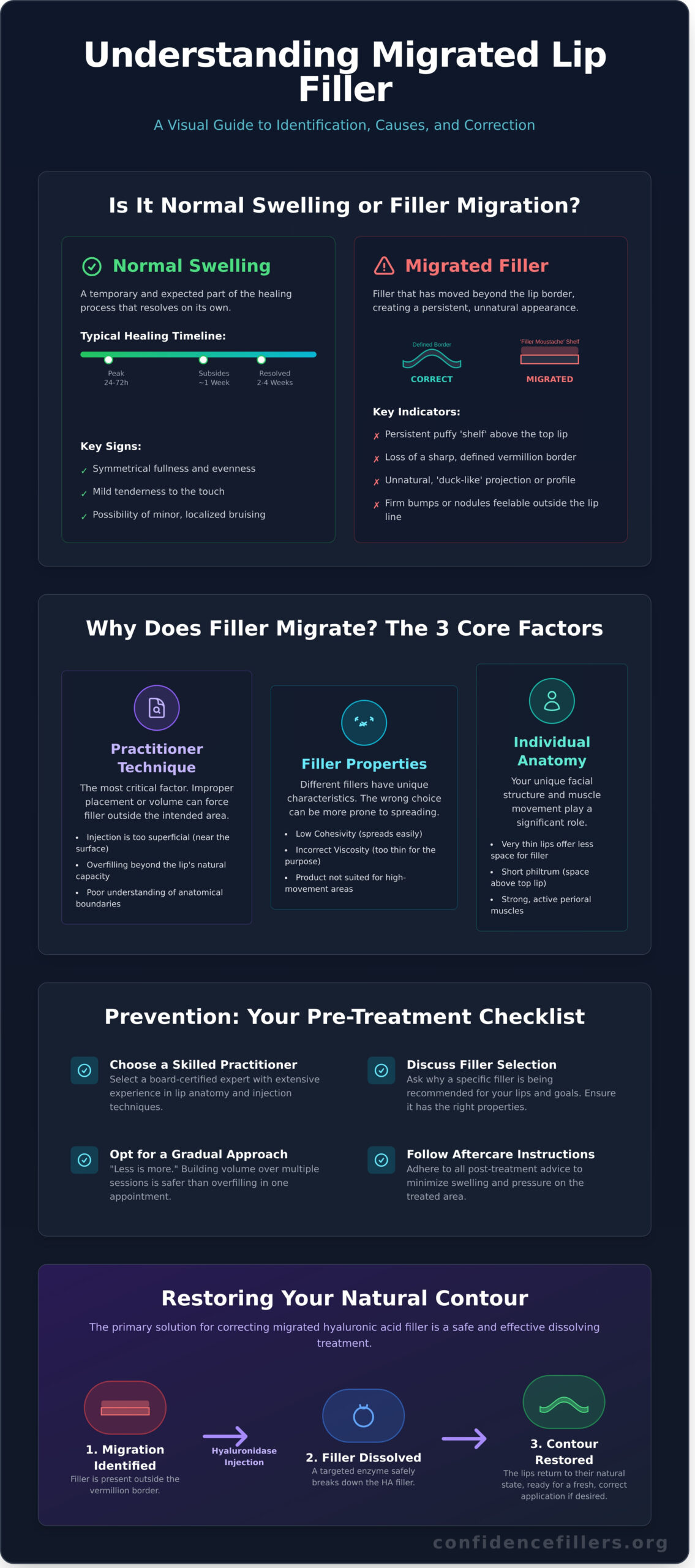
The primary challenge is distinguishing between temporary, post-treatment swelling and the persistent, misplaced volume of true migrated lip filler. While initial puffiness is expected, migration presents a distinct set of visual and palpable signs that remain long after the normal healing period has passed. Key indicators often include:
- A persistent puffy or swollen appearance above the top lip, creating a ‘filler moustache’ or ‘shelf’.
- Loss of the sharp, defined outline of your vermillion border.
- An unnatural projection or ‘duck-like’ profile of the lips.
- The feeling of firm nodules or bumps outside of your natural lip line when you press the area.
What Does Migrated Filler Look Like?
A telltale sign of migration is the softening or complete loss of your cupid’s bow definition, resulting in a less defined and uniform upper lip shape. You might also notice a puffy or shadowy area between your nose and upper lip that wasn’t there before. In some cases, you can feel small, hard lumps of filler above the lip border, confirming the product has settled outside its intended zone and is compromising the natural, subtle result you desired.
Normal Swelling Timeline: What to Expect Post-Treatment
To ease your concerns, it’s helpful to understand the typical healing journey. You can expect swelling to peak within the first 24-72 hours post-treatment. Symmetrical fullness, tenderness, and minor bruising are all normal signs that your body is healing. By the end of the first week, this swelling should have subsided significantly. We advise waiting a full two to four weeks for all inflammation to resolve completely. If the signs mentioned above persist beyond this period, it may be time to schedule a follow-up consultation.
The Science Behind Migration: A Triangle of Technique, Product & Anatomy
Achieving beautiful, natural-looking lip enhancement is much like building a bespoke structure: the outcome depends entirely on the quality of the materials, the skill of the builder, and the integrity of the foundation. When results are less than perfect, leading to migrated lip filler, it is rarely due to a single cause. Instead, it is almost always an interplay between three core factors: the practitioner’s technique, the properties of the filler itself, and your own unique anatomy.
Factor 1: Injection Technique and Overfilling
The artistry of a lip filler treatment lies in precision. If a practitioner injects the product too superficially (too close to the skin’s surface), it can become visible and create a puffy, unnatural look above the lip border. Furthermore, the temptation to achieve dramatic volume in a single session can lead to overfilling. A responsible injector understands that the lips have a finite capacity. Attempting to exceed this ignores the natural anatomical barriers, such as the vermilion border, forcing the filler into surrounding areas where it doesn’t belong.
Factor 2: The Properties of the Dermal Filler
Not all dermal fillers are created equal. Each product has specific properties, primarily its cohesivity (how well it holds together) and viscosity (its thickness and resistance to flow). A softer, less cohesive filler might be ideal for subtle hydration but is more prone to spreading if not placed with absolute precision. An expert practitioner must select the perfect product for your goals and anatomy, understanding how it will behave once injected. For a deeper understanding of product safety, the official FDA information on dermal fillers provides a comprehensive overview of their approved uses and potential risks.
Factor 3: Your Unique Lip Anatomy
Your individual anatomy provides the canvas for any aesthetic treatment. Certain features, such as very thin lips or a short philtrum (the area between your nose and top lip), can present a higher risk for migration as there is less space to accommodate the filler. Additionally, the perioral muscles around your mouth are incredibly active. Frequent and strong muscle movements from talking, smiling, and eating can, over time, place pressure on the filler and encourage it to move. This is never your ‘fault’; rather, it is a critical consideration that a meticulous practitioner factors into your bespoke treatment plan to ensure a lasting, beautiful result.
How to Prevent a ‘Filler Moustache’: Your Pre-Treatment Checklist
After addressing existing concerns, the next step is to approach future treatments with renewed confidence. Preventing a recurrence of migrated lip filler is paramount, and you are in the best position to ensure your next experience delivers the subtle, beautiful results you deserve. This pre-treatment checklist is designed to empower you, transforming you from a passive patient into an active partner in your aesthetic journey.
Using this guide will help you select a practitioner and a plan that prioritises both your safety and your desired natural-looking outcome.
Choosing Your Aesthetic Practitioner
Your choice of practitioner is the single most important factor in achieving safe, exquisite results. A true expert combines medical precision with artistic vision. Here is what to look for:
- Verify Medical Qualifications: Ensure your practitioner is a registered doctor, nurse, or dentist in the UK with specific, advanced training in aesthetic medicine. This is the foundation of safe and ethical care.
- Review Their Portfolio: Ask to see a portfolio of their work, focusing on lip enhancements for patients with a similar lip shape and anatomy to yours. Look for crisp definition and natural-looking volume, not just size.
- Demand a Thorough Consultation: A quality practitioner will conduct a comprehensive consultation, assessing your unique facial structure, listening to your goals, and explaining why their proposed plan is a bespoke solution for you.
Questions for Your Bespoke Treatment Plan
A collaborative treatment plan is key. Asking the right questions ensures you and your practitioner are aligned, prioritising the long-term health and beauty of your lips. A deep understanding of product properties and injection technique is crucial, as confirmed by extensive research on filler migration, which highlights how these factors influence final outcomes.
- ‘What specific filler product do you recommend for my lips and why?’ Different dermal fillers have different properties. Your practitioner should be able to explain why a certain product’s viscosity and cohesivity are ideal for creating your desired look while minimising risks.
- ‘What is your approach to building volume? Do you recommend a gradual approach?’ The ‘less is more’ philosophy is the gold standard. Building volume over multiple sessions significantly reduces the risk of overfilling-a primary cause of migrated lip filler.
- ‘How do you plan to maintain a sharp vermillion border and prevent migration?’ This expert question prompts a discussion about technique. A skilled injector will explain how they respect your natural lip boundary to create definition without product spillage into the perioral area.
Correcting Filler Migration: A Complete Guide to Your Options
Discovering that your lip filler has moved can be disheartening, but we want to offer complete reassurance that there are safe, clinically-proven, and effective ways to restore your lips’ natural beauty. Your journey back to feeling confident in your appearance is our primary focus. The key is to seek professional guidance, as the right solution is always a bespoke one, tailored precisely to your unique situation.
A crucial note on safety: Under no circumstances should you attempt to massage, press, or otherwise treat migrated lip filler at home. This can worsen the issue, cause bruising, or lead to other complications. Corrective work requires the anatomical knowledge and skill of a qualified medical aesthetics practitioner.
Option 1: Therapeutic Massage
For very minor migration caught extremely early, a skilled practitioner may be able to use a specific therapeutic massage technique to gently guide the filler. This is a delicate, controlled process performed in a clinical setting. It is considered the least invasive approach but is only suitable for a small number of cases and is not a guaranteed solution for filler that has already settled outside the lip border.
Option 2: Waiting for Natural Absorption
If the migration is minimal and does not cause you significant distress, patience can be a viable option. The hyaluronic acid (HA) used in modern dermal fillers is not permanent; your body will naturally break it down and absorb it over time. Depending on the type of filler used and your metabolism, this process typically takes between 6 to 18 months. This path allows for a gentle, natural reset without intervention.
Option 3: Dissolving with Hyaluronidase
For more significant or noticeable cases of migrated lip filler, dissolving the product with an enzyme called hyaluronidase is the gold-standard treatment. This is a highly effective, prescription-only medical procedure that delivers swift and predictable results, offering you a clean slate from which to achieve your aesthetic goals.
- The Consultation: Your journey begins with a thorough assessment. A patch test is usually performed to ensure you have no allergic reaction to the enzyme.
- The Procedure: A small amount of hyaluronidase is precisely injected into the areas where the filler has migrated. The enzyme works quickly to break down the hyaluronic acid molecules.
- The Results: You will notice a visible reduction within 24-48 hours as the unwanted filler is safely metabolised by your body.
Choosing the right path forward is a decision that should be made with a trusted expert. A personalised consultation will allow us to assess your lips and create a tailored treatment plan designed to restore both their beautiful shape and your complete confidence. To begin your bespoke journey, we invite you to schedule a private consultation with our specialists.
Dissolving Filler: How Hyaluronidase Safely Reverses Migration
Discovering that your lip filler has migrated can be disheartening, but the solution is both effective and remarkably safe. The gold standard for correcting migrated lip filler is a treatment using hyaluronidase, an enzyme that offers a precise and controlled way to restore your natural lip contour. This naturally occurring enzyme specifically targets and breaks down hyaluronic acid (HA), the very substance that makes up most modern dermal fillers. In the hands of a skilled practitioner, it acts as a reset button, allowing you to begin your aesthetic journey anew with confidence.
What to Expect During a Dissolving Appointment
Your journey to correcting filler migration begins with a thorough consultation. To ensure your safety, a small patch test is typically performed to rule out any rare allergic reactions to hyaluronidase. During the treatment itself, the enzyme is injected with a very fine needle directly into the areas where the filler has moved. You may feel a slight stinging sensation, but the process is generally quick. Afterwards, it is normal to experience some swelling and potential bruising, similar to your initial filler appointment. This is a temporary response to the injections and typically subsides within a few days.
After Dissolving: Re-filling and Restoring Your Lips
Once the hyaluronidase has dissolved the unwanted filler, your lips will return to their natural state. It is standard practice to wait approximately two weeks before considering re-treatment. This allows any swelling to fully resolve and ensures the hyaluronidase is no longer active, providing a clean canvas for your practitioner. Returning to a highly skilled, medically qualified professional is paramount for this next step. They will have the anatomical knowledge and artistic eye to re-inject the filler correctly, delivering the subtle, beautiful enhancement you originally desired and restoring your confidence in the process.
For aesthetic practitioners dedicated to achieving impeccable, safe results for their clients, using premium products is non-negotiable. For professionals: Explore our range of hyaluronidase and premium dermal fillers.
Achieving Lip Artistry and Reclaiming Your Confidence
Understanding the delicate interplay between injector technique, product choice, and individual anatomy is the first step toward preventing unwanted outcomes. However, should you or your clients face the challenge of migrated lip filler, it is reassuring to know that safe and effective solutions, like dissolving with hyaluronidase, are readily available. This knowledge empowers both patients and practitioners to approach lip enhancements with assurance and a clear plan for achieving beautiful, natural-looking results that inspire self-assurance.
For the discerning aesthetic professional, achieving this level of artistry and client safety begins with the quality of your tools. At Confidence Fillers, we exclusively supply licensed medical professionals with a wide range of premium, reputable filler brands, all delivered with secure and discreet worldwide shipping. Equip your practice with the finest products and instill absolute confidence in every treatment.
Your journey toward mastering the art of subtle, radiant lip enhancement is a commitment to both beauty and integrity. Embrace it with confidence.
Frequently Asked Questions About Migrated Lip Filler
Can migrated lip filler go away on its own?
While all hyaluronic acid fillers naturally dissolve over time, waiting for migrated filler to disappear on its own is not a practical solution. This process can take many months, or even years, during which the undesirable aesthetic will remain. For a precise and timely correction that restores your confidence, we recommend professionally dissolving the filler with hyaluronidase. This allows us to return your lips to their natural state, creating a clean slate for future enhancements.
Is dissolving lip filler painful?
Your comfort is central to every procedure we perform. The dissolving process involves a series of small injections, which may cause a brief, sharp sting. To ensure a calm and comfortable experience, we typically apply a strong topical numbing cream to the area beforehand. The treatment itself is very quick, and our expert practitioners are highly skilled at minimising any discomfort, allowing you to feel at ease throughout your appointment.
How quickly does hyaluronidase work to dissolve migrated filler?
The results of hyaluronidase are remarkably swift. The enzyme begins breaking down the hyaluronic acid filler almost immediately upon injection. While some initial swelling from the injections may occur, you will typically see a significant reduction in the unwanted filler within 24 to 48 hours. This rapid action allows for a quick restoration of your natural lip contour, so you can feel confident in your appearance without a lengthy waiting period.
How long do I have to wait to get more filler after dissolving?
To achieve aesthetic excellence and ensure the safety of your treatment, we advise a waiting period of at least two weeks after a dissolving session. This allows the hyaluronidase to fully process and any residual swelling to completely subside. This essential pause ensures your lips are a perfect canvas for your next treatment, allowing our practitioners to artistically sculpt your desired shape with precision for a beautiful, natural-looking result.
Does massaging my lips after treatment help prevent migration?
Following the bespoke aftercare plan provided by your practitioner is paramount. In some cases, a very specific, gentle massage technique may be recommended to help integrate the filler. However, incorrect or overly aggressive massage can disrupt the placement of the product and actively contribute to migration. Always adhere strictly to the professional guidance you are given to protect the integrity of your treatment and ensure a flawless, lasting result.
Can you get more lip filler if you already have some migration?
We would strongly advise against adding new filler on top of existing migrated lip filler. This approach almost always worsens the problem, contributing to a lack of definition and an unnatural, “puffy” look that undermines a refined aesthetic. The most ethical and effective solution is to first dissolve the misplaced product completely. This allows us to redefine your lip border with artistry and precision, ensuring your new treatment enhances your features beautifully.
What type of filler is least likely to migrate?
Filler migration is often more dependent on injector technique and the volume used rather than the product itself. However, fillers with a higher cohesivity and firmness (known as G-prime) tend to hold their shape better and are less prone to spreading. Products within premier ranges like Juvéderm® are designed for specific tissue planes. A skilled practitioner will select the ideal product for your unique anatomy to ensure a stable, beautifully integrated, and natural-looking outcome.
Will dissolving filler affect my natural lips?
When performed by an experienced medical professional, dissolving filler is an exceptionally safe procedure. Hyaluronidase is specifically formulated to target the synthetic hyaluronic acid used in fillers and does not harm your natural tissue or your body’s own hyaluronic acid. Your lips will simply return to their pre-filler state. This provides a safe and reliable method to reset your aesthetic journey, empowering you to move forward with absolute confidence.