

In the pursuit of aesthetic excellence, your choice of tool is as critical as your technique. For the modern aesthetic professional, navigating the ever-expanding landscape of dermal fillers presents a distinct challenge. From differentiating between the rheological properties of leading UK brands to ensuring you can confidently manage any potential complication, the responsibility to deliver safe, sublime, and natural-looking results rests firmly on your expertise.
This comprehensive guide is designed to be your trusted clinical companion. We move beyond the marketing to provide a clear, evidence-based exploration of filler science, brand technologies, and crucial safety protocols. Our goal is to empower you with the nuanced understanding required to make impeccable, bespoke treatment decisions for every client, enhancing not only their appearance but their deep-seated confidence. Consider this your definitive resource for achieving mastery in aesthetic rejuvenation and elevating your practice to the next level.
Key Takeaways
- Master the science of rheology to precisely match filler properties to treatment goals, moving beyond basic composition to achieve predictable, sophisticated outcomes.
- Learn to map specific filler characteristics, such as G’ and viscosity, to distinct facial anatomy for creating structure, lift, and contour with artistic precision.
- Compare the leading dermal fillers on the UK market by their core cross-linking technologies, enabling you to select the optimal product for each bespoke treatment plan.
- Elevate your clinical practice with a comprehensive framework for patient safety, from pre-treatment consultation to advanced complication management techniques.
The Science of Dermal Fillers: Understanding Composition and Rheology
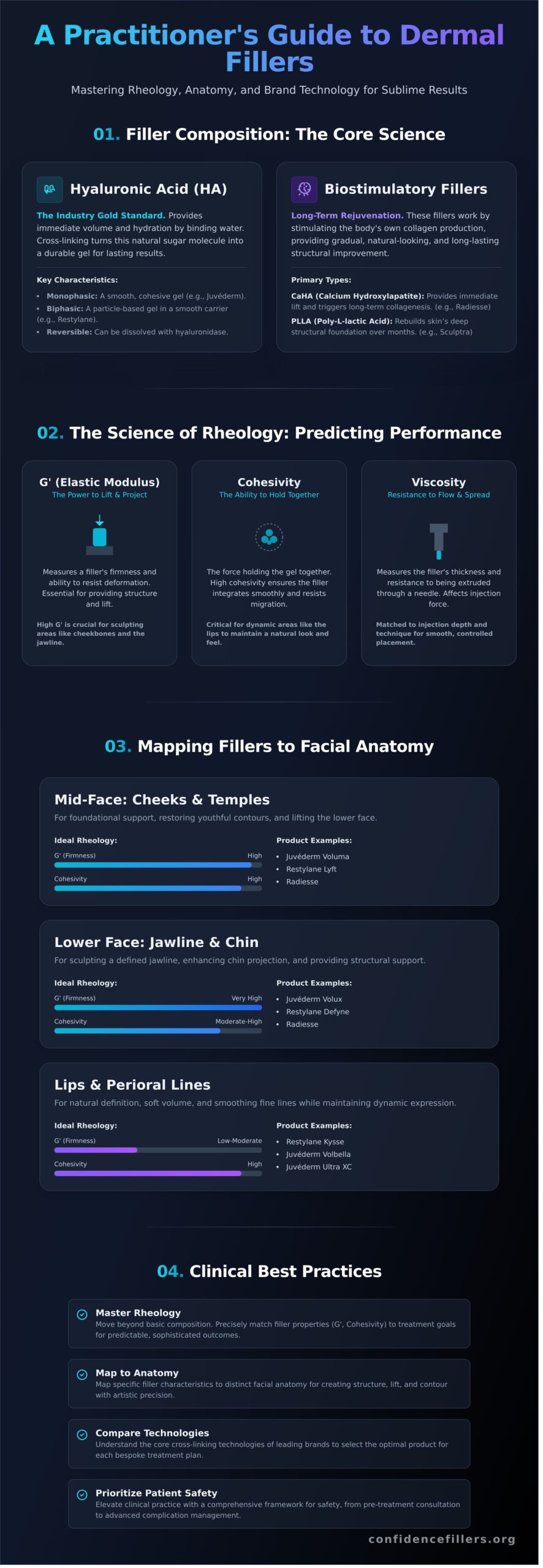
To achieve the subtle, confidence-boosting results you deserve, it is essential to look beyond the surface. Dermal fillers are not merely cosmetic products; they are sophisticated medical devices designed for precise tissue augmentation. Their effectiveness lies in a dual-action mechanism: they provide immediate volume to restore youthful contours while some formulations also stimulate your body’s own collagen production for long-term rejuvenation. The true artistry, however, comes from understanding their rheology-the science of how these gels flow, lift, and hold their shape within the skin. This knowledge is what allows a skilled practitioner to select the perfect filler for a predictable and beautifully natural-looking outcome.
Hyaluronic Acid (HA): The Industry Gold Standard
Hyaluronic Acid is a sugar molecule (a glycosaminoglycan) that occurs naturally in your skin, where it helps retain moisture and plumpness. In fillers, this HA is stabilised through a process called cross-linking, which transforms it from a liquid into a durable gel, ensuring longevity. The specific dermal filler composition, whether monophasic (a smooth, cohesive gel) or biphasic (a particle-based gel), determines its texture and behaviour. Leading brands like Juvéderm and Restylane have perfected this technology to create a diverse portfolio for every aesthetic need.
Biostimulatory Fillers: CaHA and PLLA
For those seeking gradual, long-lasting improvement, biostimulatory fillers offer a powerful alternative. Unlike HA fillers that primarily add volume, these work by stimulating your own collagen. Calcium Hydroxylapatite (CaHA), found in Radiesse, provides some immediate lift but its main benefit is the collagenesis it triggers over time. Poly-L-lactic Acid (PLLA), the key ingredient in Sculptra, works almost entirely by rebuilding your skin’s deep structural foundation. The results appear slowly over several months, making them ideal for holistic volume restoration rather than fine-tuning specific lines.
Key Rheological Properties for the Practitioner
The selection of the ideal filler for your bespoke treatment plan is guided by its physical properties. An expert practitioner considers these three key factors to ensure the product performs exactly as needed:
- G’ (Elastic Modulus): This measures the filler’s firmness and ability to lift tissue. A high G’ is essential for sculpting structural areas like the cheekbones and jawline, providing projection without spreading.
- Cohesivity: This is the filler’s ability to hold together. High cohesivity ensures the gel integrates smoothly and resists migration, which is crucial for dynamic areas like the lips.
- Viscosity: This refers to the filler’s resistance to flow. A practitioner matches the viscosity to the injection depth and technique to ensure smooth, controlled placement and a comfortable experience for you.
Mapping Fillers to Facial Anatomy: A Treatment Area Guide
Achieving truly natural-looking results with dermal fillers is an art grounded in science. The key is a bespoke treatment plan that honours your unique facial structure, selecting the perfect product for each area. We exclusively use premium, well-researched products, similar in quality and safety to the range of FDA-approved dermal fillers, ensuring every treatment is safe and effective. Understanding which filler works where is fundamental to creating a harmonious, confident look.
Lip Enhancement and Perioral Lines
For lips that are beautifully defined and naturally soft, the chosen filler must be exceptionally flexible. We select products with a low to moderate G’ (firmness) that integrate seamlessly, allowing them to move with your natural expressions. This avoids stiffness and is crucial for subtly smoothing vertical ‘smoker’s lines’ without adding unwanted bulk.
- Ideal Properties: High flexibility, low-to-moderate firmness, smooth integration.
- Product Examples: Restylane Kysse, Juvéderm Volbella, Juvéderm Ultra XC.
Mid-Face Volumization: Cheeks and Temples
Restoring volume to your cheeks and temples provides foundational support that lifts and rejuvenates the entire face. Here, a filler with a high G’ and cohesivity is required to create structure and maintain shape. By placing these robust fillers deep against the bone (supraperiosteal placement), we can restore youthful contours and provide a subtle, elegant lift to the lower face.
- Ideal Properties: High G’ for lift, high cohesivity for shape.
- Product Examples: Juvéderm Voluma, Restylane Lyft, Radiesse.
Lower Face Contouring: Jawline, Chin, and Marionette Lines
A sharp, defined jawline and a well-proportioned chin create facial balance. This requires a structural filler with a very high G’ and viscosity to mimic bone. Products like Juvéderm Volux are engineered for this purpose. Conversely, for dynamic marionette lines, a softer, more flexible filler is chosen to ensure natural movement when you speak or smile.
- Ideal Properties: Very high G’ for structure (jaw/chin); flexibility for marionette lines.
- Product Examples: Juvéderm Volux, Juvéderm Voluma, Restylane Defyne.
Fine Lines and Skin Quality: Tear Troughs and Neck
Treating delicate areas like the under-eye (tear trough) or fine neck lines demands a specialised product. We use fillers with low viscosity and low firmness that integrate seamlessly under thin skin. This precision helps avoid puffiness or the Tyndall effect-a bluish hue. For an all-over improvement in skin texture and hydration, we may recommend skin boosters like Restylane Skinboosters.
- Ideal Properties: Low viscosity, low G’, high spreadability.
- Product Examples: Restylane Eyelight, Juvéderm Volbella, Belotero Balance.
A Comparative Review of Leading Dermal Filler Brands
Navigating the world of aesthetic medicine reveals that not all dermal fillers are created equal. The key to a successful, natural-looking enhancement lies in understanding the science that differentiates each brand. At the heart of this science is proprietary cross-linking technology, which dictates how a hyaluronic acid (HA) gel behaves once injected-its firmness, flexibility, and longevity. These advanced formulations are rigorously developed to ensure both safety and efficacy, a process detailed in resources like the FDA Guide to Dermal Fillers, providing practitioners with a predictable and reliable toolkit.
The Juvéderm® Collection (Allergan Aesthetics)
Juvéderm is renowned for its smooth, malleable gels that deliver exceptionally natural results. Its classic products, such as Juvéderm Ultra, use Hylacross™ technology to create a highly cohesive gel ideal for correcting moderate lines and adding volume to the lips. The more advanced Vycross™ line (including Voluma, Volbella, and Volux) features more efficient cross-linking, resulting in longer-lasting fillers with specific properties. Vycross products are tailored for distinct goals: Voluma restores cheek contour, Volbella offers subtle lip enhancement, and Volux provides sharp definition to the jawline.
The Restylane® Portfolio (Galderma)
Restylane offers two distinct technologies to address a wide range of aesthetic concerns. The NASHA™ technology (e.g., Restylane, Restylane Lyft) produces a firmer, particle-based gel designed to provide robust support and significant lifting capacity, making it excellent for structuring cheeks and correcting deeper folds. In contrast, the XpresHAn™ technology (e.g., Refyne, Defyne, Kysse) creates a more flexible, elastic gel that integrates smoothly into dynamic areas, allowing for natural expression in the nasolabial folds and lips without feeling stiff.
Other Key Players: Radiesse®, Belotero®, and Teosyal®
Beyond the two market leaders, other innovative brands offer unique solutions. Radiesse® stands apart as a calcium hydroxylapatite (CaHA) filler that not only provides immediate volume but also stimulates your body’s own collagen production for long-term improvement. Belotero®, with its Cohesive Polydensified Matrix (CPM) technology, is celebrated for its ability to integrate seamlessly into fine lines. Finally, Teosyal® and its Resilient Hyaluronic Acid (RHA) line are specifically designed to adapt to facial movements, making them ideal for preserving natural dynamics.
Selecting the right product is a cornerstone of a bespoke treatment plan. An expert practitioner will choose the filler whose properties best align with your unique anatomy and aesthetic goals to restore volume, structure, and confidence. To see the premium brands we trust for our clients, explore our curated selection of dermal filler brands.
Clinical Best Practices: Safety, Technique, and Complication Management
In the pursuit of aesthetic excellence, patient safety remains the non-negotiable foundation of our practice. A practitioner’s reputation is built not only on artistry but on a rigorous commitment to clinical vigilance. This dedication to safe, ethical, and effective outcomes is a responsibility we all share. It is the cornerstone of building patient trust and elevating the standard of care across the industry.
Patient Assessment and Aseptic Protocol
Every successful treatment begins with a meticulous consultation. This involves a thorough review of the patient’s medical history to screen for contraindications and a frank discussion to align their expectations with achievable, natural-looking results. Comprehensive informed consent and detailed clinical documentation are not just procedural formalities; they are vital for patient protection and professional integrity. Before injection, a strict aseptic technique-including skin preparation with a suitable antiseptic like chlorhexidine-is essential to minimise the risk of infection.
Injection Techniques: Needle vs. Microcannula
The choice of tool significantly influences both safety and outcomes. While sharp-tip needles offer precision for specific techniques like bolus injections, they carry a higher risk of bruising and intravascular events. In contrast, blunt-tip microcannulas are designed to navigate through tissue planes, displacing vessels rather than piercing them. This makes them an invaluable tool for reducing trauma and enhancing safety, particularly in high-risk vascular zones like the temples, tear troughs, and nasolabial folds. A profound understanding of facial anatomy is paramount, regardless of your chosen instrument.
Managing Adverse Events: From Bruising to Vascular Occlusion
While common side effects like mild swelling and bruising can be managed with post-treatment advice, preparedness for severe adverse events is critical. A vascular occlusion (VO) is a medical emergency that every injector must be able to identify and manage instantly. Key signs include:
- Immediate, intense, or radiating pain
- Skin blanching or a dusky, mottled appearance (livedo reticularis)
- Delayed capillary refill
If a VO is suspected, you must initiate your emergency protocol without delay. This typically involves stopping the injection, attempting to aspirate the product, applying warmth, and administering high-dose hyaluronidase. Every practitioner using dermal fillers has an ethical and professional duty to maintain a fully stocked and up-to-date emergency kit, with ample hyaluronidase readily accessible.
At Confidence Fillers, we see ourselves as your partners in upholding these standards. We are committed to supporting practitioners who prioritise safety and continual learning. For more on our educational resources and commitment to clinical excellence, please visit confidencefillers.org.
Elevating Your Practice with Aesthetic Excellence
Mastery in aesthetic medicine is a synthesis of science, artistry, and an unwavering commitment to patient safety. As we’ve explored, a profound understanding of product rheology, precise anatomical mapping, and rigorous clinical technique are the cornerstones of delivering the exceptional, natural-looking results your patients seek. This expertise not only elevates patient outcomes but also builds the trust and confidence that define a distinguished practice.
To achieve this level of excellence, sourcing authentic, high-calibre dermal fillers is paramount. Confidence Fillers is your partner in this pursuit. Our extensive portfolio features industry-leading brands like Juvéderm and Restylane, all available through a secure online platform with reliable worldwide shipping. More than a supplier, we provide the dedicated support that aesthetic professionals like you need to operate with absolute assurance.
Source authentic, industry-leading dermal fillers for your clinic.
Here’s to building your practice on a foundation of quality, safety, and confidence.
Frequently Asked Questions
What is the primary difference between monophasic and biphasic HA fillers?
The primary difference lies in their physical structure. Monophasic fillers are a smooth, cohesive gel, allowing for seamless integration into tissue for very soft, natural results. In contrast, biphasic fillers consist of gel particles suspended within a smoother gel, which can provide more defined structure and lift. The choice depends entirely on your aesthetic goals and the treatment area, ensuring your result is both beautiful and tailored specifically to you.
How does a filler’s G-prime influence its use in facial contouring?
G-prime is a scientific measure of a filler’s firmness and ability to hold its shape. A product with a high G-prime is firm and structural, making it ideal for building and defining contours in areas like the jawline, chin, and cheeks. A lower G-prime indicates a softer, more flexible gel, which is perfectly suited for dynamic areas like the lips or for subtly smoothing fine lines, ensuring your natural expressions remain beautifully intact.
What are the legal and professional requirements for administering dermal fillers?
In the United Kingdom, for your utmost safety, you should only receive treatment from a qualified and insured medical professional, such as a doctor, dentist, or prescribing nurse. While regulations are evolving, we strongly advise choosing a practitioner registered with a professional standards body like the Joint Council for Cosmetic Practitioners (JCCP) or Save Face. This ensures they are committed to the highest standards of ethical care and aesthetic excellence.
How should dermal fillers be properly stored in a clinical setting to maintain efficacy?
To guarantee both safety and efficacy, dermal fillers must be stored according to strict clinical protocols. They are typically kept at a controlled room temperature, well away from direct sunlight and extreme heat or cold, which can compromise the product’s integrity. Every professional clinic meticulously follows the specific manufacturer’s guidelines for each product, as this attention to detail is fundamental to delivering the safe, predictable, and beautiful results you deserve.
What is the role of hyaluronidase, and should every injector have it on hand?
Hyaluronidase is an essential enzyme that dissolves hyaluronic acid-based fillers. Its role is twofold: to reverse an aesthetic outcome you are unhappy with, or, more critically, to manage rare but serious complications. It is an non-negotiable safety tool. Every reputable, ethical, and professional practitioner must have hyaluronidase immediately accessible in their clinic at all times. Your safety is the absolute priority, and this is a fundamental standard of care.
How long do different types of dermal fillers (HA vs. CaHA) typically last?
Longevity varies based on the filler type, treatment area, and your individual metabolism. Hyaluronic Acid (HA) fillers, such as those from the Juvéderm® or Restylane® collections, typically provide results that last between 6 and 18 months. Calcium Hydroxylapatite (CaHA) fillers like Radiesse® often last longer, around 12 to 18 months or more, as they also act as a biostimulant, encouraging your own natural collagen production for sustained rejuvenation.
Can different brands of dermal fillers be used in the same patient?
Yes, and this is common practice for an expert injector creating a bespoke treatment plan. A skilled practitioner will often select different fillers from various brands to achieve the most harmonious and natural-looking outcome. For instance, they might use a firm, structural filler to define the jawline and a soft, flexible filler to enhance the lips. This tailored approach ensures each part of your face is treated with the precise product needed for aesthetic excellence.